Defining Enterprise Policies @ Red Hat
Leading development of enterprise policies and features.
Role:
Product Manager
Company:
Red Hat
Tools:
Figma, NotebookLM, Excel
CONTEXT
Red Hat's Enterprise Accessibility program needed a defined path forward, with no existing research, no fixed scope, and no precedent to work from. I owned it end to end: scoping, recruiting, and running 35 interviews across 5+ functional groups over three months. Accessibility is additionally closely tied to SEO and AI agent readability, highlighting the impact of my work.
THE PROBLEM
Going in, the assumption was that teams lacked accessibility knowledge. Interviews disproved it. Teams understood the standards; what they lacked was a shared definition of a compliant handoff, and a process that enforced it regardless of who was on the team.
WHAT I FOUND
The failure was at the handoff, not the knowledge. Two designers on separate teams described a "compliant" handoff in different terms, and neither was wrong, because policy never defined it. The best fix was already happening informally, on teams that had built shared understanding on their own, and it outperformed every formal policy in place. I also observed that teams whose managers scoped accessibility in at kickoff delivered consistently; teams that treated it as a final check didn't.
THE SOLUTION
I prioritized several recommendations and presented my findings to 90+ stakeholders, including VPs and leadership. Recommendations were tied to data and business outcomes.
Having formalized metrics and concrete outcomes helped when working with auditing and troubleshooting for individual teams where I was able to address pushback from skeptical teams.
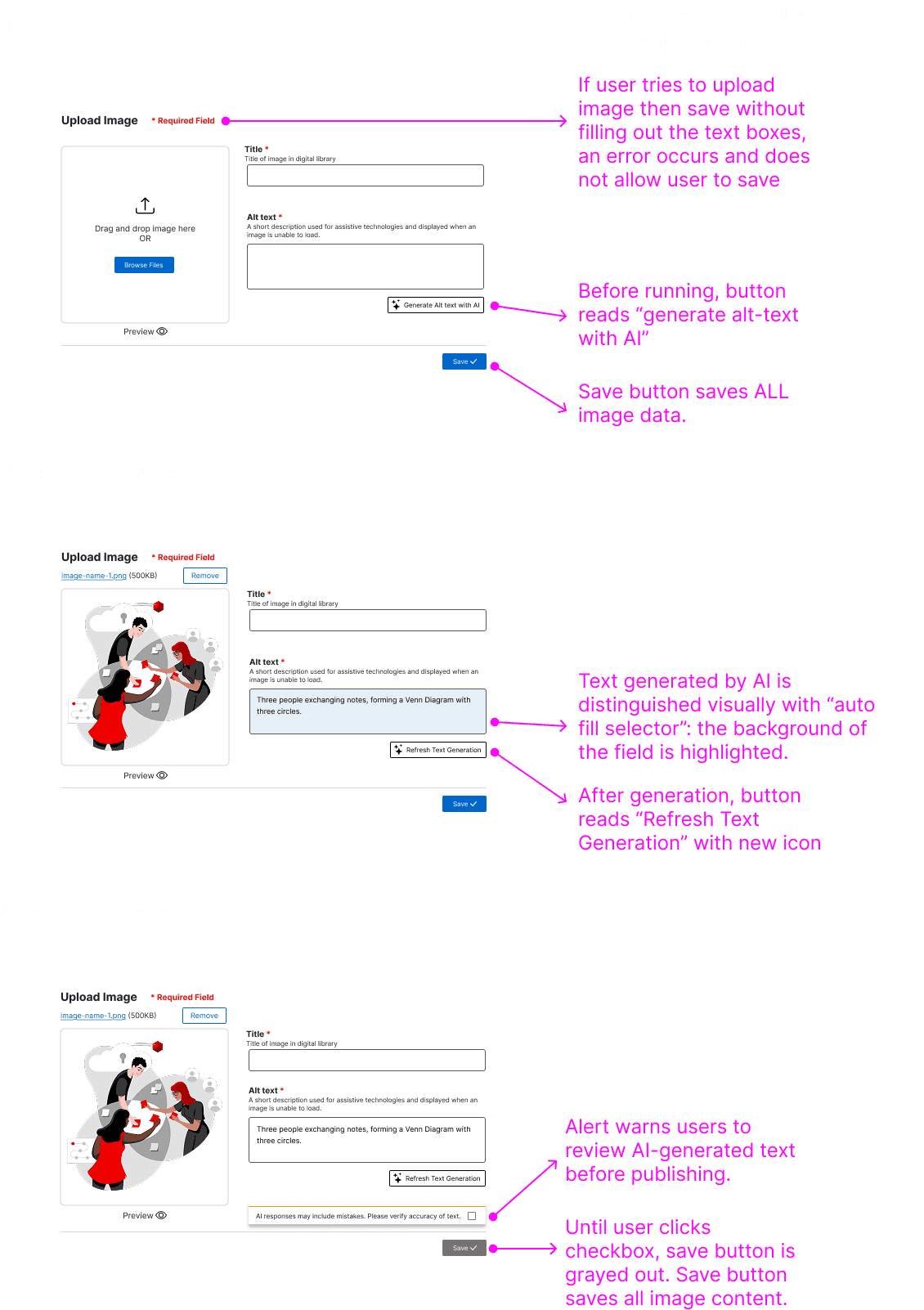
Finally, I also prototyped an AI alt-text generator with a mandatory human review step, including requirements, acceptance criteria, and user stories; aimed at cutting errors without removing human accountability. The feature was published within Drupal, supporting accessibility compliance across 20,000+ employees.
OUTCOMES
35 interviews across 5+ functional groups, self-scoped and self-recruited
More than 6 comprehensive recommendations prioritized for reach and feasibility
Presented to 90+ stakeholders, including VP-level leadership
Managers and the Digital Product Management team updated internal policies, SDLC workflows, and priorities to highligh accessibility compliance.
Alt-text tool published, reducing accessibility errors by a projected 80%.
REFLECTION
I focused primarily on enterprise policy and internal team workflows, prioritizing handoff improvements and discovery work. I took the initiative to collaborate and publish a feature addressing several of the key issues my team encountered as well. Overall, I learned a lot about product management and discovery methods.